
Catch up on the retail design, construction, merchandising, and installation ideas Dynamic has covered during the first six months of 2026.
The first half of 2026 has reinforced something Dynamic has learned through more than 32 years in retail: customers always expect more from your stores.
Nearly 75% of consumers surveyed for a 2026 IBM and National Retail Federation study still shop in stores. At the same time, 45% use AI somewhere in the buying journey.
Customers are entering your stores with more information, clearer expectations, and a short list of their buying options. But your store still has to support them through their buying journey — helping them see, compare, understand, and feel confident about what they buy.
In our first nine blogs of 2026, we wrote about how to create better stores, make experiential and technology-enabled ideas useful, design for real customers, manage construction, and avoid installation problems.
Retail Store Design and Construction: Build a Better Shopper Experience
A strong shopper experience starts well before fixtures arrive on-site. Retail store design and construction connect the initial concept to the physical details customers eventually see and use: layout, millwork, lighting, graphics, materials, product displays, checkout areas, and pathways through the store.
This work is most effective when design and execution are planned together. Site information affects drawings. Drawings affect fabrication and trade coordination. Materials and finishes affect lead times, cost, installation, and maintenance.
When these decisions are disconnected, the finished store may look different from the design or create problems for customers and staff.
The goal is not simply to create a good-looking store. The space should make products easier to discover, compare, test, and buy. It also has to work for the employees supporting customers and maintaining the environment after opening day.

Dynamic’s work for Astrid & Miyu shows how those pieces come together. The Belfast project included a full store fit-out, architectural drawings, electrical and plumbing work, and millwork installation. This was part of a broader relationship supporting stores and pop-ups in Europe and the U.S.
Read Retail Store Design and Construction: How to Build a Better Shopper Experience.
Experiential Merchandising: Give Customers a Reason to Visit
The Experiential merchandising turns a marketing idea into something customers can see, touch, participate in, or explore inside the store.
The opportunity to use experiential marketing is very real; however, the experience must have a clear purpose.
More than 40% of Gen Z and millennial consumers surveyed by ICSC and McKinsey said experiential retail makes them more likely to shop with a retailer.
A strong experiential marketing idea needs more than a clever theme – it must align with our five Cs of experiential marketing:
- Consistency: ensure your idea works across all stores and pop-ups
- Customer: always start with the customer first
- Concept: what is the core idea behind the experience
- Context: how you’ll bring the idea to your retail store
- Connection: why will customers feel compelled to participate

The Jellycat shop-in-shop at FAO Schwarz is one example. The installation gives customers a playful setting in which to stop, explore, and connect with the products, while keeping the experience grounded in Jellycat’s recognizable brand world.
Read Your Customers Want Experiential Merchandising: How to Deliver a Memorable Retail Experience.
Augmented Reality in Retail Stores: Make the Technology Useful
Augmented reality works best when it helps customers understand products and make confident buying decisions. The technology might appear through a phone, in-store screen, virtual mirror, product visualization tool, or interactive display.
Keep these seven practical benefits of augmented reality in retail stores in mind:
- Personalized: help customers see products in colors, styles, or configurations that are relevant to them.
- Convenient: make it easier to try on, compare, or request products without adding friction to the shopping experience.
- Product visualization: show customers how furniture, finishes, products, or configurations may look in a real space.
- Navigation and discovery: guide customers through large stores, complex product ranges, service areas, or promotions.
- Confidence-building: help customers compare sizes, colors, finishes, fit, and other details before committing to a purchase.
- Immersive: make a display more engaging when the experience supports a clear product or brand story.
- Educational: give customers useful information about features, materials, care, customization, or product use.
The golden rule is simple: augmented reality should solve a customer problem. The fixture, lighting, power, privacy, sightlines, floor space, staff support, and installation all need to work with the technology.
Read Augmented Reality in Retail Stores: Practical Uses and Retail Installation Considerations.
Sustainable Retail Design: Plan for the Full Project Lifecycle
It should not come as a surprise that your customers care about sustainable retail design and sustainable brands:
- 50% of surveyed consumers said the ability to recycle a product once they’re finished using it influenced their buying decision
- 44% of surveyed consumers are more likely to buy from a brand with a clear sustainability commitment
- 35% of surveyed brands are investing in establishing long-term sustainability goals and targets
- 35% of surveyed consumers prioritize having a transparent, accountable, and socially and environmentally responsible supply chain
- 83% of millennials expect brands to align with their values
- 53% of surveyed companies are making sustainability a top priority, including improving manufacturing processes and using more sustainable packaging
Sustainable retail needs to be part of your retail strategy.
Read How to Implement Sustainable Retail Design Strategies.
Customer Demographics: Design for How People Actually Shop
Customer demographics help retailers understand who shops with them. Psychographics help explain why those customers buy.
Both should influence your retail design decisions, from layout and fixture density to color, signage, technology, product presentation, and the amount of space customers need to browse.
A mission-driven shopper may want clear sightlines and fast access to core categories. A customer who wants to explore may need more room to pause, compare products, and discover something new.
A store that tries to support every shopping behavior equally ends up serving none of them particularly well.
Retail teams should start with actual customer data and a clear understanding of how people use their stores:
- What do people buy?
- Where do they hesitate?
- Which displays get attention without converting?
- Do customers know where to go when they enter?
Knowing this information prevents you from designing a store for an imaginary customer.

Dynamic’s work for Monica Vinader used detailed millwork and carefully selected materials to support the quality and craftsmanship customers associate with the brand. It is a useful reminder that materials, display details, and store atmosphere all communicate who the space is designed for.
Read How Customer Demographics in Retail Impact Your Retail Design and Brand.
Retail Construction Project Managers: Bring Oversight in Early
A retail construction project manager coordinates the designers, contractors, trades, vendors, installers, and internal stakeholders involved in turning a store design into a finished environment.
Hiring a retail construction manager who understands the current retail market and how customer demands are reshaping what a store can be gives you a competitive advantage.
In our experience, hiring a retail construction manager is essential for any project:
- Before the design is finalized
- When you’re managing multiple locations or rollouts
- When internal teams are stretched
- When timelines or budgets are tight
- When consistency matters to your brand
Whether you’re updating existing retail stores, building a brand-new retail store, preparing for a global roll-out of new stores, or adding brick-and-mortar retail to your DTC portfolio – you need to hire a retail construction manager.
You’re an expert in your brand, products, and services. You’re not an expert in retail construction, design, management, logistics, or planning.
The success of your retail construction project is directly linked to your retail construction manager and their network of industry contacts.
Read Should You Hire a Retail Construction Project Manager?
Retail Construction Management: Know What to Expect
Retail construction management keeps the people, information, materials, schedules, and decisions behind a store build coordinated from planning through close-out.
Know the four phases of retail construction management:
- Conception and planning: define what the retail space needs to achieve, review the site, and develop the project plan, surveys, drawings, budget, and design direction.
- Pre-construction: confirm contracts, timelines, permits, approvals, materials, delivery schedules, trade responsibilities, and the full construction plan.
- Construction: coordinate the work on-site, track progress, manage trades and deliveries, communicate issues, and check that the build follows the approved plans.
- Project close-out: inspect the finished store, document corrections, confirm that the space meets the brand and design requirements, and plan for maintenance or future rollouts.
Good retail construction management is built on coordination. Designers, architects, contractors, installers, suppliers, and internal teams need current information and a clear understanding of what happens next. Small issues are easier to solve before they delay the opening or affect the finished store.
Read What to Expect from Retail Construction Management.
Retail Millwork Installation: Avoid Expensive, Preventable Mistakes
Retail millwork installation problems are expensive, stressful, and often preventable. Treating installation as part of the project plan from day one helps protect your schedule, budget, fixtures, and finished store design.
Avoid these seven costly retail millwork installation mistakes:
- Not hiring a retail installation company to manage and install fixtures, millwork, graphics, window displays, and other store elements.
- Relying on outdated architectural drawings, site surveys, or informal walkthroughs instead of confirming current site conditions.
- Underestimating the logistics involved in deliveries, staging, material handling, store access, security requirements, and installation scheduling.
- Forgetting to coordinate with electrical, HVAC, lighting, security, plumbing, data, and other trades and project partners.
- Following retail design trends that do not fit your established brand identity, customer expectations, or store environment.
- Overlooking sustainable choices when planning store fixtures, millwork, materials, maintenance, reuse, and eventual replacement.
- Assuming sales and customer service employees can manage the maintenance of fixtures, millwork, graphics, and the retail interior.
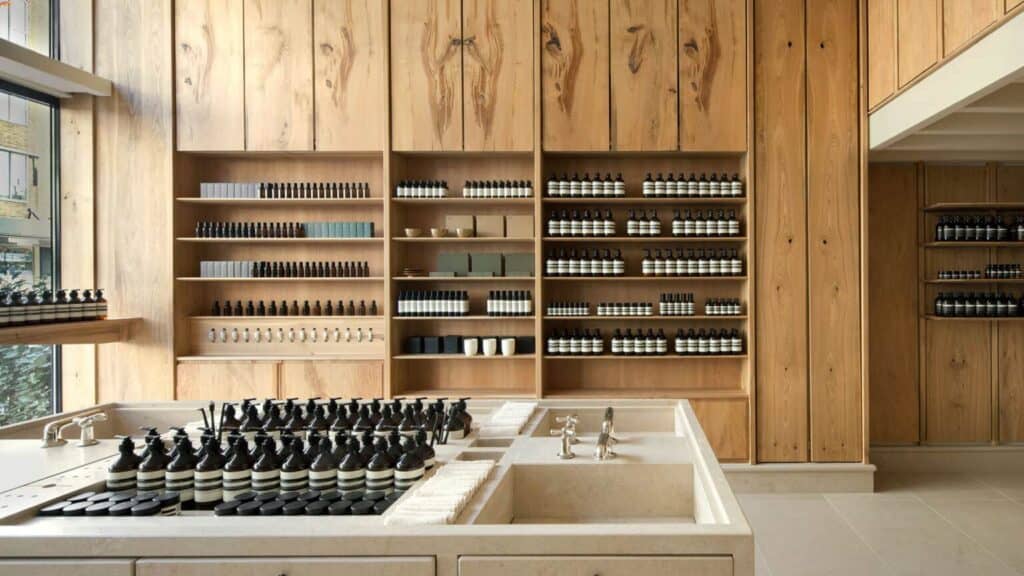
Dynamic’s work for Aesop involved demolition, HVAC, plumbing, mechanical and electrical work, custom framework, basement fit-out, limestone flooring, and material sourcing. The project underscores why millwork installation, construction, site conditions, and trade coordination need to be managed as one connected project.
Read 7 Costly Mistakes Retail Millwork Installation Companies Help You Avoid.
Professional Graphic Installers: Protect the Brand in the Store
Retail graphics do much more than decorate walls and windows. Their color, scale, placement, messaging, and installation help customers understand the brand and move through the store.
Keep these five roles of graphics in visual merchandising in mind:
- Setting customer expectations: in-store graphics communicate brand quality, value, style, and the type of experience customers can expect.
- Storytelling and product marketing: strategically placed graphics help customers discover products, understand promotions, and connect products to the wider brand story.
- Making a first impression: graphics and window displays quickly tell people whether the store is relevant to them and worth entering.
- Building brand awareness and loyalty: consistent colors, imagery, logos, and messaging reinforce brand values and help customers recognize and trust the brand.
- Customer wayfinding: signs, wall graphics, and floor graphics help customers navigate the store, find products, and follow a clear shopping journey.
These roles depend on professional execution. Accurate site information, suitable materials, careful placement, coordinated lighting, and a clean installation all affect whether the graphics communicate the right message.

For Warby Parker, Dynamic installed custom branding, graphics, and wall coverings across retail locations. Local artist imagery gives each store a distinct connection to its market while the installation remains consistent with the broader Warby Parker brand.
Read How Professional Graphic Installers Bring Retail Brands to Life In-Store.
These first six months of 2026 point to one practical conclusion: a successful retail environment connects customer insight, design intent, construction planning, and installation execution.
Technology should make shopping easier. Experiential ideas should have a clear purpose. Sustainable choices should work across the project lifecycle. Construction and installation teams should be involved early enough to prevent avoidable problems.
That is how a concept becomes a store customers can understand, use, and remember.
Contact us to learn how we handle any aspect of your business – from an individual retail store to a global brand roll-out. We are here for you.